Trenching a utility line, digging footings for a new structure, or cutting a pond bank all start the same way in Rowan County: knowing exactly what’s buried before the bucket goes in the ground. Jenkins All Terrain LLC provides excavation contractor services across the 60-mile radius around Landis and China Grove, handling everything from utility trenching to footing excavation for residential property owners. Every job starts with an NC811 utility locate, not as an afterthought but as the first step, because Rowan County’s mix of older rural properties and newer subdivisions means buried lines aren’t always where a homeowner expects them. Call (980) 400-2223 or request a free estimate to get a site evaluated.
What Excavation Actually Involves
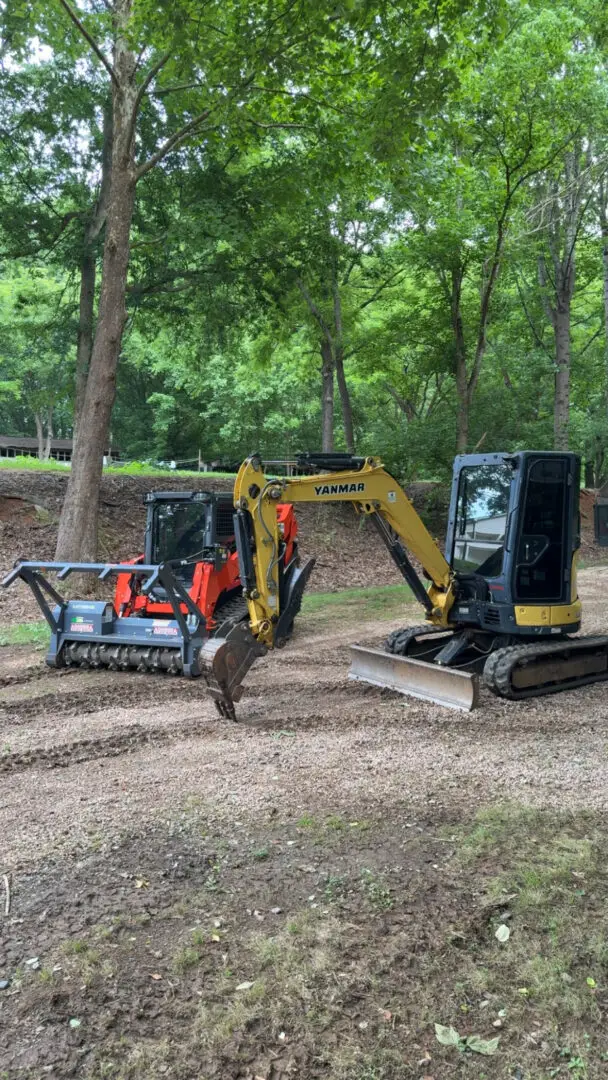
Excavation is the controlled digging, moving, and shaping of earth for a specific purpose — a utility trench, a footing, a pond, or a drainage line — as opposed to grading, which reshapes a surface for slope and drainage. The process starts with an NC811 utility locate request, which by North Carolina law must be submitted at least three full working days before digging begins, so member utilities can mark buried electric, gas, water, and communication lines on site. Once lines are marked and confirmed clear, excavation proceeds with equipment matched to the job — a mini excavator for tight residential trenching, a full-size excavator for footings or pond work, and hand-digging near marked utility lines where equipment can’t safely get close. Spoil (the dirt removed) is either stockpiled on-site for backfill, hauled off, or used as fill elsewhere on the property, depending on the job. On trenching work specifically, depth and width are cut to the exact specification the utility or pipe requires — too shallow risks damage later, too deep wastes time and backfill material. For homeowners, excavation is usually the least visible but most consequential phase of a project: get it wrong and problems show up months later as a settled trench line or a footing that doesn’t bear weight correctly; get it right and it’s invisible once backfilled and graded over.
Our Excavation Process
Step 1 — Site Walk & Scope. Mason reviews the plans or the general area of work — a trench line, a footing layout, a pond bank — and talks through depth, access, and any known obstacles before quoting the job.
Step 2 — NC811 Utility Locate. We submit a locate request to NC811 at least three full working days before digging, as required by North Carolina law, and wait for all member utilities to mark or clear the work area before equipment moves.
Step 3 — Excavation. Digging proceeds with equipment sized to the job — mini excavators for tight residential trenching, larger equipment for footings or pond work — cut to the exact depth and width the project calls for.
Step 4 — Spoil Management. Removed material is stockpiled for backfill, hauled off-site, or used as fill elsewhere on the property, keeping the work area manageable rather than leaving mounded dirt scattered across the yard.
Step 5 — Backfill & Site Cleanup. Once the underlying work is complete — pipe laid, footing poured, or pond shaped — the excavation is backfilled, compacted, and the site is left graded and cleaned up rather than in the condition heavy equipment typically leaves behind.
Serving China Grove and the Surrounding Area
Jenkins All Terrain handles excavation work throughout China Grove, Landis, and Salisbury, and out to the growth corridor around Kannapolis, Concord, and Mooresville, where new-construction utility trenching and footing work is common. In the more rural areas around Gold Hill, Rockwell, and Cleveland, excavation jobs lean toward pond banks, drainage lines, and septic-related digging on larger properties. Piedmont red clay affects excavation differently than it does grading — it holds a clean trench wall well once cut, but it’s dense and heavy to move, which is part of why equipment sizing matters for keeping a job on schedule.
Why China Grove Property Owners Choose Jenkins All Terrain
Excavation work at Jenkins All Terrain runs on the same principle as every other service: quality over quantity, and doing the job right rather than fast and cheap. That approach shows up in the business’s 37 five-star Google reviews. Because excavation carries real safety and liability risk — struck utility lines cause outages, injuries, and fines — the NC811 locate step isn’t optional or skipped to save time, even on small residential jobs.
North Carolina’s Underground Utility Safety and Damage Prevention Act requires anyone excavating to notify NC811 at least three working days ahead, and failing to do so risks damage, injury, and legal liability that falls on the property owner as well as the contractor. On larger excavation jobs that disturb more than an acre, NC DEQ’s erosion and sediment control rules also come into play, and Jenkins All Terrain scopes that into the estimate up front. Learn more about the team on our About Us page, or see our grading and turnkey site work pages for related services.
What Our Customers Say About Our Excavation Work
Jenkins All Terrain’s 37 five-star Google reviews span the full range of site work services, including excavation, trenching, and drainage jobs.


