Piedmont red clay doesn’t forgive a bad grade — water either sheets off correctly or it pools against a foundation, erodes a new driveway, or turns a yard into standing mud after the next storm off I-85. Jenkins All Terrain LLC works as a grading contractor across Rowan County, shaping house pads, driveways, and drainage so water moves where it’s supposed to instead of where gravity happens to take it. Grading is one of the two services, alongside forestry mulching, that Mason Jenkins built the business on, and it’s frequently the step that comes right after clearing or right before a gravel driveway or hydroseeded lawn goes in. Call (980) 400-2223 or request a free estimate to get your site evaluated.
What Grading Actually Involves
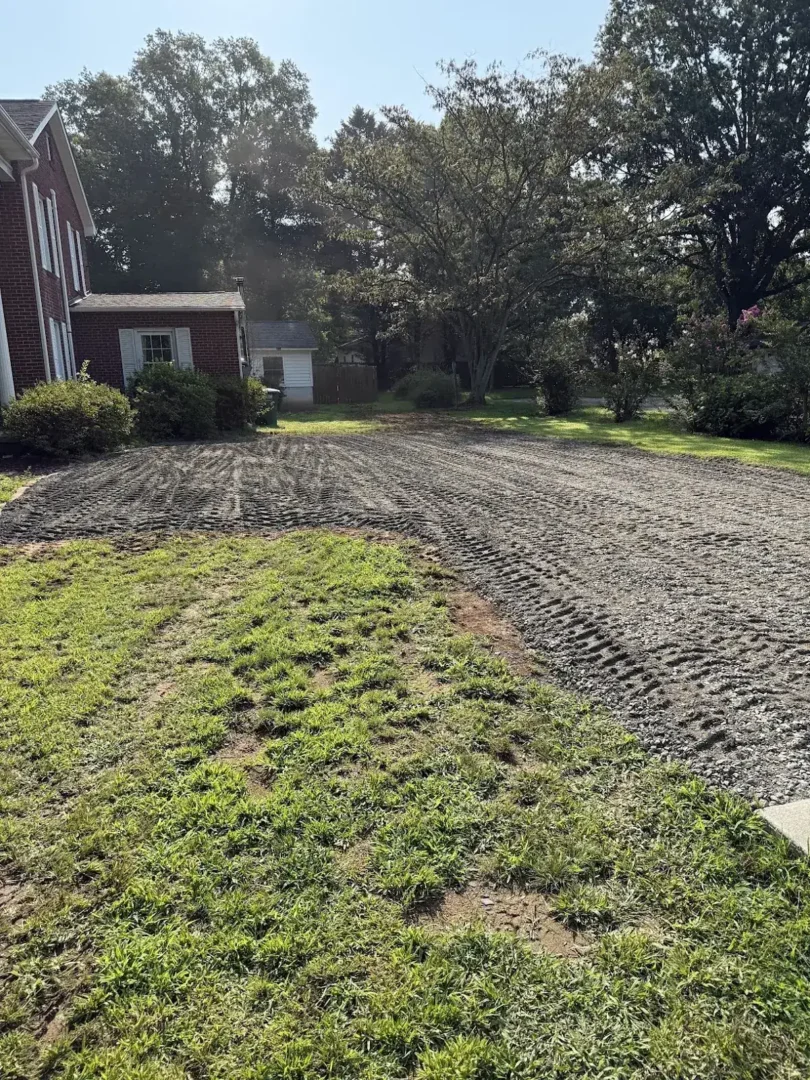
Grading is the process of reshaping the ground’s surface — cutting high spots, filling low spots, and establishing consistent slope — so water drains away from structures and doesn’t pool, erode, or wash out driveways and walkways. The work typically starts with rough grading using a dozer or skid steer with a box blade to move bulk material and establish the general shape of the site, followed by finish grading, where a smaller, more precise pass — often with a box blade or grading rake — sets the final slope and smooths the surface for whatever comes next, whether that’s gravel, sod, or hydroseed. On a driveway or house pad, the target is usually a slope of around 2% away from the structure, enough to move water without being so steep it erodes on its own. Rowan County’s dense, slow-draining red clay makes this step less forgiving than it would be in sandier soil — a poorly graded yard here holds water for days after a hard rain instead of draining through. Customers typically see this job move from a rutted, uneven, or poorly-draining lot to a smooth, properly-sloped surface within a day or two, ready for the next phase of work.
Our Grading Process
Step 1 — Site Walk & Drainage Assessment. Mason evaluates existing slope, low spots, and where water is currently pooling or running before quoting the job, and talks through what the finished grade needs to accomplish — a driveway, a house pad, or a yard that stops holding water.
Step 2 — Rough Grading. Using a dozer or skid steer, bulk material is cut from high areas and moved to fill low spots, establishing the general shape and slope of the site. This is the heavy-equipment phase where most of the material actually moves.
Step 3 — Compaction. Fill material is compacted in passes rather than dumped and left loose, which matters most in Rowan County’s clay soil — uncompacted fill settles unevenly over time and can crack a driveway or cause a low spot to reappear.
Step 4 — Finish Grading. A final, precise pass sets the exact slope and smooths the surface, typically targeting a gentle grade away from structures so water sheds correctly without creating erosion.
Step 5 — Site Ready for Next Phase. The graded surface is left ready for gravel, sod, hydroseed, or construction — smooth, properly sloped, and no longer holding water where it used to pool.
Serving China Grove and the Surrounding Area
Jenkins All Terrain grades residential lots throughout China Grove, Landis, and Salisbury, and out along the growth corridor toward Kannapolis, Concord, and Mooresville, where new construction on former farmland means dealing with fresh-cut red clay that hasn’t settled yet. In the more rural stretches around Rockwell, Gold Hill, and Cleveland, grading work leans toward driveways and drainage on larger acreage rather than new-build subdivisions. Piedmont clay is the constant across all of it — it compacts hard once properly worked but drains poorly and erodes fast if a slope is left wrong, which is why finish grading matters as much as the rough cut.
Why China Grove Homeowners Choose Jenkins All Terrain
Grading is one of Jenkins All Terrain’s two core advertised services, and Mason treats it as connected work — a clearing or mulching job often reveals drainage problems that grading then solves, and a graded pad frequently leads straight into a gravel driveway or hydroseeding job. The company’s approach, in Mason’s own words, is quality over quantity, reflected in 37 five-star Google reviews built on residential work rather than large commercial contracts.
Grading that disturbs more than an acre of ground triggers North Carolina’s erosion and sediment control requirements — a plan must be filed with the state, and permanent groundcover has to be established within 15 working days or 90 calendar days of the disturbance, whichever comes first, under the NC DEQ erosion and sediment control rules. Jenkins All Terrain scopes this into larger jobs from the start rather than leaving a customer to find out about it after the fact. Before any digging that disturbs the subsurface, the crew also calls NC811 to have utility lines marked. Learn more about the team on our About Us page, or see our excavation and gravel driveway pages for the work that typically follows grading.
What Our Customers Say About Our Grading
Grading and forestry mulching are the two services Jenkins All Terrain is best known for, reflected in the business’s 37 five-star Google reviews.


